


For many women, breast augmentation is a life-enhancing procedure that provides increased confidence and a more balanced silhouette. However, as with any surgical intervention involving the placement of a foreign object into the body, there is a risk of complications. Among the most common and frustrating of these is capsular contracture. This condition occurs when the internal scar tissue (the “capsule”) that naturally forms around a breast implant becomes abnormally thick, tight, and constricted.
At Banobagi Plastic Surgery, we prioritize long-term patient health through advanced diagnostic imaging and meticulous surgical techniques. Understanding how to detect the early signs of contracture and knowing the modern management options in breast augmentation Korea is vital for maintaining both the aesthetic and functional success of your surgery.
Understanding the Biological “Capsule”
It is a biological fact that whenever a medical device, such as a pacemaker, joint replacement, or breast implant, is placed in the body, the immune system responds by creating a thin layer of protective scar tissue around it. This is known as a capsule. In a healthy recovery, this capsule remains soft, flexible, and virtually unnoticeable, acting as a natural pocket that holds the implant in place.
Capsular contracture happens when this normal healing process goes into “overdrive”. The scar tissue begins to shrink and squeeze the implant, leading to various degrees of firmness, distortion, and eventually, physical pain.

How to Detect Capsular Contracture: The Baker Scale
Plastic surgeons categorize the severity of contracture using the Baker Scale, which ranges from Grade I to Grade IV.
Grade I: Natural and Soft
- Appearance: The breast looks completely natural.
- Feel: The breast is soft to the touch, and the capsule is undetectable.
- Symptoms: No symptoms; this is the ideal result of a successful augmentation.
Grade II: Minimal Firmness
- Appearance: The breast still appears normal in shape.
- Feel: The breast feels slightly firmer than a natural breast but is not yet hard.
- Symptoms: The patient may notice a subtle change in texture but typically experiences no pain.
Grade III: Moderate Firmness and Distortion
- Appearance: The breast begins to look “round,” “hard,” or “pulled up” as the capsule tightens and pulls the implant out of its natural position.
- Feel: The breast feels firm or hard to the touch.
- Symptoms: The patient may feel a persistent “tight” sensation.
Grade IV: Severe Firmness and Pain
- Appearance: The breast is visibly distorted, often appearing cold, unnaturally high, or misshapen.
- Feel: The breast is hard, rigid, and may feel like a solid ball.
- Symptoms: This stage is characterized by physical pain, tenderness, and significant discomfort.
Causes and Risk Factors
While the exact reason why some patients develop contracture and others do not is still being researched, several factors have been strongly linked to the condition:
- Biofilm (Subclinical Infection): Small amounts of bacteria can enter the breast pocket during surgery, creating a “biofilm” that triggers a chronic inflammatory response, leading to thickened scar tissue.
- Hematoma or Seroma: The accumulation of blood or fluid around the implant post-surgery increases the risk of the capsule hardening.
- Implant Rupture: In older silicone models, “silent ruptures” or gel bleeds could irritate the surrounding tissue.
- Genetic Predisposition: Some individuals are naturally prone to developing “keloids” or thick scar tissue.
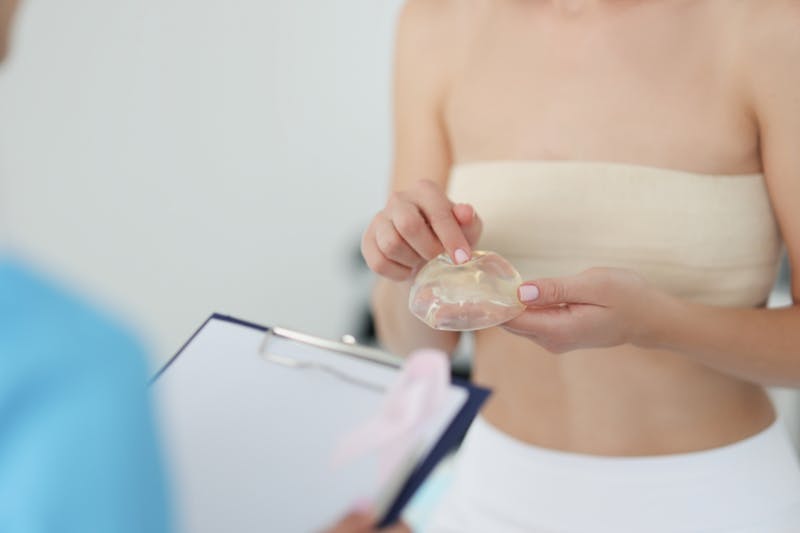
Managing and Treating Capsular Contracture
Once capsular contracture reaches Grade III or IV, medical or surgical intervention is required to restore the breast’s health and appearance.
Non-Surgical Management (Early Stages)
For Grade II cases, specialists may recommend conservative measures:
- Medication: Certain asthma medications (Leukotriene antagonists) have been shown to help soften early-stage scar tissue in some patients.
- Massage: Specific therapeutic massages may be prescribed to keep the pocket open, though this must be done only under a surgeon’s guidance.
Surgical Management (Advanced Stages)
For Grade III and IV, surgery is the gold standard for treatment.
- Capsulotomy: The surgeon makes incisions in the scar tissue to release the tension and expand the pocket.
- Capsulectomy: The entire hardened capsule is surgically removed. This is often the preferred method at Banobagi to ensure all inflammatory tissue is cleared.
- Implant Exchange: The old implants are removed and replaced with new ones, often using a different surface texture (such as moving to highly cohesive “gummy bear” implants) to reduce the chance of recurrence.
- Pocket Change: Moving the implant from a subglandular (above the muscle) position to a submuscular or dual-plane position can provide more tissue coverage and a lower risk of future contracture.
The Banobagi Prevention and Recovery Protocol
At Banobagi Plastic Surgery, we utilize a “Total Care” system designed to minimize the occurrence of contracture and manage it effectively if it arises.
1. Full-HD Endoscopic Precision
By using Full-HD endoscopes during the initial breast augmentation Korea, our surgeons can visualize every blood vessel, significantly reducing the risk of hematomas—a major cause of contracture.
2. The Keller Funnel Technique
We use specialized delivery sleeves to place the implant into the breast pocket without it ever touching the patient’s skin, dramatically reducing the risk of bacterial contamination and biofilm formation.
3. Specialized Aftercare
Our 4-step aftercare system includes high-frequency and ultrasound therapy. These treatments improve circulation and help keep the internal tissues soft and supple during the critical first few months of healing.
4. Continuous Monitoring
We provide regular ultrasound screenings to monitor the integrity of the implants and the thickness of the capsule, allowing us to detect and treat Grade II issues before they progress to more painful stages.
Conclusion
Capsular contracture is a manageable complication, but early detection is the key to a successful outcome. By paying close attention to changes in the feel and shape of your breasts and attending regular follow-up appointments, you can ensure your breast augmentation remains a source of joy rather than discomfort.
At Banobagi, we combine technical mastery with compassionate care to support you throughout your entire aesthetic journey. If you suspect you are experiencing firmness or distortion, do not wait for pain to develop. Professional evaluation is the first step toward restoring your natural, soft results.
Begin Your Journey
Connect with our expert surgeons to discuss your goals and discover the ideal approach tailored to you.
Why Choose Banobagi?
Two decades. Thousands of procedures. One standard: if it looks done, it's not done well enough. Every Banobagi surgeon operates within a tight specialisation. Fewer procedure types, more mastery. That's the model, and it works.
We're not the only clinic in Korea. We're the one other clinics measure themselves against.


 E-MAIL
