


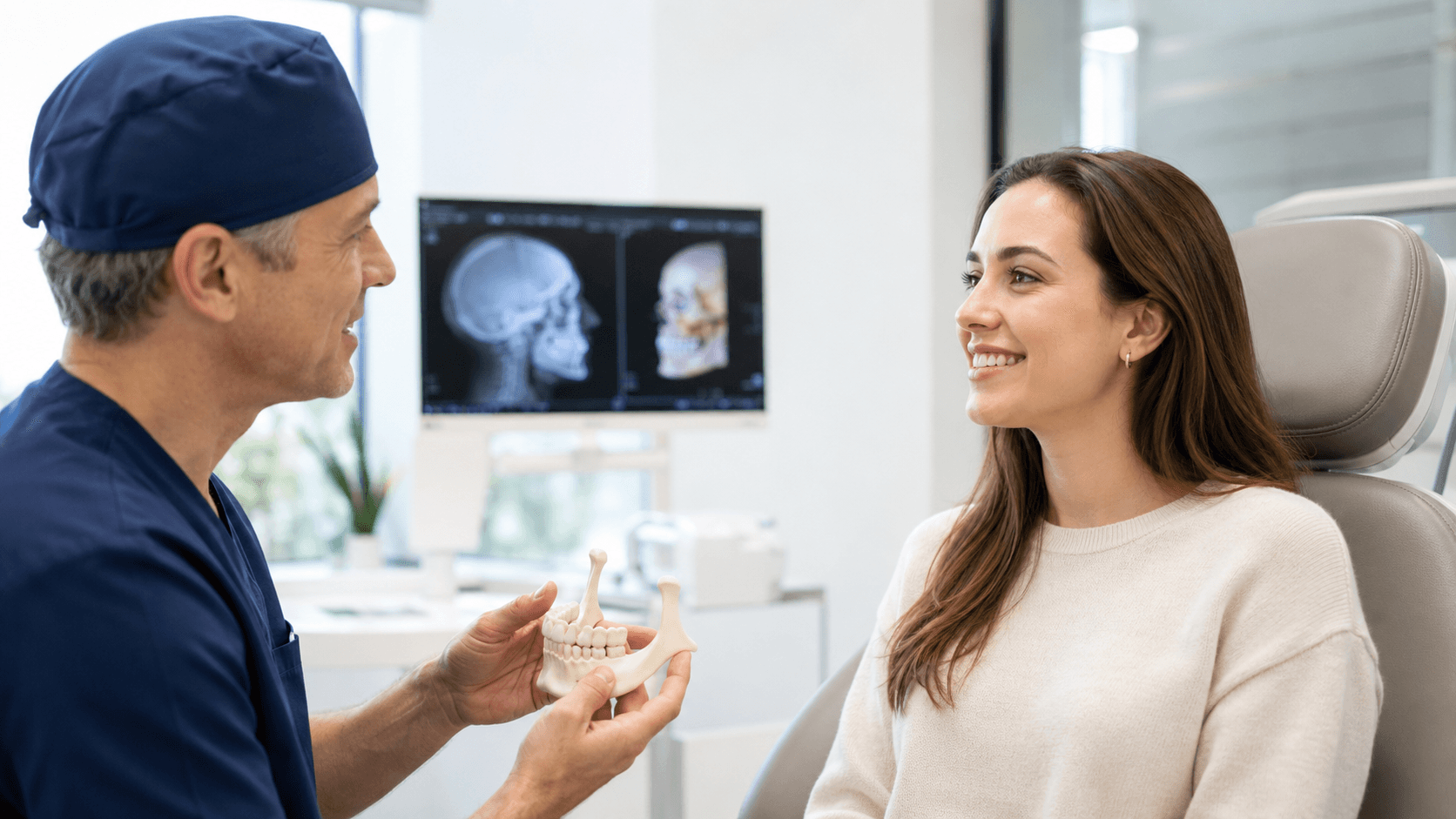
An open bite is a specific type of malocclusion where the upper and lower teeth do not make contact when the mouth is closed, leaving a visible gap. This condition can manifest as an anterior open bite, where the front teeth fail to overlap, or a posterior open bite, where the back molars do not touch. While mild cases may sometimes be managed with orthodontics, a persistent open bite in adults is often skeletal in nature, requiring specialized surgical intervention to achieve a permanent, stable result.
Successful open bite correction depends on identifying whether the gap comes from tooth position, jaw growth, or both. When the cause is skeletal, repositioning the upper jaw, lower jaw, or both can restore contact between the teeth and improve facial balance.
Why Persistent Open Bites Require Surgery
A persistent open bite is more than an aesthetic concern; it significantly impairs daily functionality and long-term dental health. When the teeth do not meet properly, several complications can arise:
- Impaired Chewing and Digestion: The inability to cut food with the incisors makes eating common foods difficult and can lead to digestive strain.
- Speech Difficulties: Open bites often cause lisps or difficulty pronouncing syllables that require placing the tongue behind the upper teeth.
- Temporomandibular Joint (TMJ) Stress: Improper bite alignment places uneven pressure on the jaw joints, potentially leading to chronic pain and TMJ disorders.
- Abnormal Tooth Wear: Because only a few teeth are making contact, they bear the full force of chewing, leading to premature wearing, fractures, and gum issues.
For many adults, orthodontic treatment alone, such as braces or aligners, may fail to close the gap because the problem lies in the growth pattern of the jawbones rather than just the position of the teeth.

The Banobagi Approach: Double Jaw Surgery in Korea
At Banobagi, we utilize orthognathic surgery (commonly known as double jaw surgery) to address the skeletal discrepancies causing a persistent open bite. This procedure involves repositioning both the upper jaw (maxilla) and lower jaw (mandible) to close the opening and ensure a proper, functional bite.
1. Advanced 3D Diagnostic Planning
Success in complex jaw surgery begins with high-precision diagnosis. We use 3D-CT scans and virtual simulation to analyze the facial structure, nerve pathways, and bone density. This allows our specialists to plan the exact rotational and translatory movements needed to close the open bite while maintaining facial harmony.
2. Multi-Specialty Cooperation
Banobagi’s key value lies in our collaborative team of board-certified plastic surgery specialists and oral and maxillofacial surgeons. This ensures that every surgical plan addresses both the functional correction of the bite and the aesthetic enhancement of the face line.
3. Bioresorbable “Osteotrans” Pins
To provide a more convenient and safe recovery, Banobagi often uses Osteotrans pins to fix the jawbones in their new positions. These bioresorbable pins are eventually absorbed by the bone, eliminating the need for a second surgery to remove metal hardware.
The Surgical Process and Techniques
During the procedure, which is performed under general anesthesia, the surgeon makes carefully planned incisions inside the mouth to access the jawbones, ensuring no external facial scars.
- Maxillary Osteotomy: The upper jaw is repositioned, often tilted or moved downward, to close the gap.
- Mandibular Osteotomy: The lower jaw is adjusted to meet the new position of the upper jaw perfectly.
- Stabilization: The bones are firmly fixed into their new locations to promote stable healing.
The surgery typically takes about 3 to 5 hours, depending on the complexity of the correction.
Recovery and Post-Operative Care
Recovery from double jaw surgery in Korea is a comprehensive process that requires patience and adherence to specialist guidance.
- Hospitalization: Patients generally stay in the hospital for 3 nights for professional monitoring and immediate post-operative care.
- Initial Healing: Significant swelling after surgery is normal and typically peaks within the first 48 hours. A specialized compression bandage is used to protect the area and manage inflammation.
- Dietary Restrictions: For the first several weeks, patients must follow a liquid or pureed diet to minimize strain on the healing jawbones.
- Return to Activity: Most patients can resume daily activities within 2 to 4 weeks, though full bone healing can take up to 12 weeks.
- Post-Surgical Orthodontics: After the jawbones have stabilized, orthodontic treatment (braces) is often required to fine-tune the final alignment of the teeth for long-term stability.

Why Choose Banobagi for Open Bite Correction?
Banobagi Plastic Surgery Clinic is a global leader in facial contouring and jaw surgery, offering a specialized environment for international patients.
- Safety Excellence: Our surgeries are supported by a team of full-time anesthesiologists who monitor patient conditions in real-time.
- Surgical Transparency: We utilize the “Surgeon Real-Name System,” ensuring that the specialist who conducts your consultation is the same expert performing the procedure.
- Comprehensive Support: From 1:1 coordinator assignments to on-site accommodations and transportation, we ensure a safe and convenient recovery experience for foreign customers.
Conclusion
A persistent open bite does not have to be a lifelong struggle. Through the expertise of double jaw surgery in Korea at Banobagi, you can achieve a permanent correction that restores your ability to eat, speak, and smile with confidence. By focusing on skeletal stability and facial balance, we help you transition from a “bad bite” to a life of functional freedom.
Begin Your Journey
Connect with our expert surgeons to discuss your goals and discover the ideal approach tailored to you.
Why Choose Banobagi?
Two decades. Thousands of procedures. One standard: if it looks done, it's not done well enough. Every Banobagi surgeon operates within a tight specialisation. Fewer procedure types, more mastery. That's the model, and it works.
We're not the only clinic in Korea. We're the one other clinics measure themselves against.


 E-MAIL
