


In the sophisticated landscape of korea eyelid surgery, the surgical goal has evolved far beyond simply creating a cutaneous crease where one did not previously exist. Today’s discerning patients seek a comprehensive transformation that enhances the eye’s clarity, brightness, and overall harmony with the unique proportions of the face. Achieving this level of “natural” beauty requires more than basic surgical steps; it demands advanced techniques that address the complex internal anatomy of the eyelid, including the strength of the levator muscle, the distribution of orbital fat, and the specific elasticity of the skin.
Advanced eyelid surgery starts with diagnosing what limits definition or openness in the individual eye. Levator strength, fat distribution, skin elasticity, and crease stability determine which techniques are appropriate. Banobagi uses these findings to build a customized plan that prioritizes natural movement, durability, and safety.
The Evolution of the Double Eyelid Technique
Historically, blepharoplasty was often seen as a standard, “one-size-fits-all” procedure. However, at Banobagi, we treat it as a high-precision art form that must account for the dynamic nature of the human face. Advanced korea eyelid surgery now focuses on achieving results that look natural not just when the eyes are closed or static, but also during active movement, expression, and blinking.
1. The Natural Adhesion (Advanced Non-Incision) Method
This technique is an evolved version of the traditional “burying” or suture method, designed for maximum subtlety.
- The Technique: Instead of simply looping a single thread through the tissue, we create a series of microscopic adhesion points between the eyelid skin and the underlying levator muscle.
- The Advantage: This creates a more secure “double-knot” effect within the tissue. This significantly reduces the chances of the crease loosening or disappearing over time while maintaining a completely scarless finish.
- Ideal Candidate: This is the preferred method for patients with thin eyelid skin and minimal fat who desire a very fast recovery with no visible incisions.
2. Dual-Plane Partial Incision Method
For patients who fall between the need for a full incision and a non-incision approach, this hybrid method is highly effective.
- The Technique: A microscopic incision (usually only 2–3mm) is made, allowing the surgeon to precisely remove excess orbital fat that might otherwise cause a “puffy” look. The crease itself is then fixed using the natural adhesion technique.
- The Advantage: It provides the long-term structural stability of an incision with the minimal swelling after surgery and rapid healing associated with non-incision procedures.
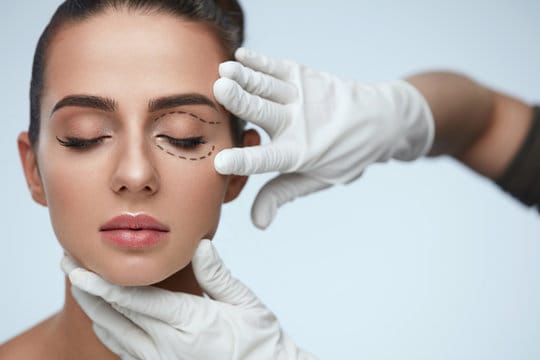
3. Advanced Full Incision (Tissue Balancing)
When significant sagging skin, thick muscle, or heavy fat deposits are present, the full incision method remains the gold standard for korea eyelid surgery.
- The Technique: Our surgeons perform a meticulous balancing act, removing redundant skin and “ROOF” fat (Retro-Orbicularis Oculi Fat) while simultaneously reinforcing the eyelid-lifting muscle.
- The Advantage: This method creates a clear, vivid, and permanent crease even in “heavy” eyes that have previously failed to maintain a line with simpler methods.
Corrective Techniques for Total Eye Radiance
Advanced eyelid surgery at Banobagi often involves more than just the creation of a crease. To achieve truly “radiant” and open eyes, we frequently address the surrounding functional and aesthetic structures.
Ptosis Correction (Eye Muscle Strengthening)
Many patients suffer from “sleepy eyes” caused by ptosis, a condition where the levator muscle is too weak to fully lift the eyelid.
- The Procedure: During the double eyelid surgery, the surgeon tightens and adjusts the levator muscle.
- The Result: This allows the eye to open wider, exposing more of the pupil and making the patient look significantly more alert and energetic without changing the eye’s natural shape.
3. Dimensional Canthoplasty
To change the horizontal or vertical dimension of the eye, we refine the inner and outer corners.
- Epicanthoplasty: This involves removing the “Mongolian fold” at the inner corner. This makes the eyes appear larger and can help bridge a wide gap between the eyes.
- Lateral Canthoplasty: By extending the outer corner, we can lengthen the eye and create a wider, more dramatic gaze.
The Banobagi Standard: Safety and Surgical Integrity
A successful outcome is built on a foundation of medical safety and specialized institutional care.
- Surgeon Real-Name System: We guarantee that the specialist you consult with is the exact expert who performs your surgery. This ensures that the aesthetic vision discussed in your consultation is executed with total technical accuracy.
- Expert Anesthesiology: Even for eyelid procedures, patient safety is never compromised. Our board-certified, full-time anesthesiologists monitor your condition in real-time, ensuring a painless and safe experience.
- Anatomical 3D Analysis: We utilize advanced diagnostics to analyze the “eye-opening” force and the specific thickness of your eyelid tissues. This prevents common complications such as the “sausage-eye” look or asymmetrical creases.
The Post-Operative Roadmap: Protecting Your Results
Advanced surgery requires a disciplined approach to recovery. To protect the delicate internal work and ensure the finest scar maturation, following the Banobagi aftercare protocol is essential.

Phase 1: The Initial Healing (Week 1)
- Managing Edema: The most significant swelling after surgery occurs in the first 72 hours. Consistent cold compresses are vital during this peak inflammatory window.
- Incision Care: Keeping the area clean with saline and prescribed ointments ensures that the incision line heals into a pale, thin mark that eventually becomes virtually invisible.
Phase 2: The Settling Phase (Month 1)
- Tissue Maturation: By the end of the first month, approximately 80% of visible swelling has resolved. The crease begins to settle into its intended natural position.
- Resuming Your Routine: Most patients can return to wearing light makeup and contact lenses once they have received formal clearance from their specialist.
Phase 3: Long-Term Refinement (Month 6)
- Final Transformation: By the six-month mark, the internal tissues have fully softened. The crease looks entirely natural, and the eyes appear bright and harmonious with the rest of your facial features.
Conclusion
Advanced techniques in korea eyelid surgery are designed to reveal the most beautiful and radiant version of your eyes while prioritizing long-term health, functionality, and stability. At Banobagi Plastic Surgery Clinic, we combine decades of clinical experience with innovative surgical technology to ensure your journey is safe, professional, and life-changing.
Your eyes are the window to your confidence. Let us help you ensure that your story is told with clarity, beauty, and precision.
Begin Your Journey
Connect with our expert surgeons to discuss your goals and discover the ideal approach tailored to you.
Why Choose Banobagi?
Two decades. Thousands of procedures. One standard: if it looks done, it's not done well enough. Every Banobagi surgeon operates within a tight specialisation. Fewer procedure types, more mastery. That's the model, and it works.
We're not the only clinic in Korea. We're the one other clinics measure themselves against.


 E-MAIL
