


While breast augmentation is one of the most popular aesthetic procedures, rare complications like symmastia can occur, significantly impacting a patient’s confidence and comfort. Often informally referred to as a “uniboob,” “breadloafing,” or “kissing implants,” symmastia is a condition where the breast implants migrate toward the center of the chest and meet at the midline. This causes the skin and underlying tissue to lift away from the sternum (breastbone), creating a single, continuous breast appearance instead of two separate units.
At Banobagi Plastic Surgery, our approach to breast surgery is rooted in anatomical detail and safety. We provide specialized revision breast surgery for patients suffering from acquired symmastia, utilizing advanced techniques to reconstruct the breast pockets and restore natural cleavage.
Identifying the Signs of Symmastia
Symmastia can be congenital (present from birth), but it is most commonly an acquired condition resulting from a primary breast augmentation. It may appear shortly after the initial surgery or develop years later as tissues stretch over time.
Visual and Physical Symptoms
- Loss of Cleavage Separation: The natural medial (inner) cleavage lines disappear, replaced by a “bridged” or “single-breasted” appearance.
- Unnatural Proximity: The breasts appear joined together or fused into one continuous structure in the center of the chest.
- Skin Tenting: The skin over the breastbone no longer rests firmly against the chest wall; it may appear “tented” up as the implants shift inward.
- Pain and Discomfort: Patients often experience a “pulling” sensation or localized pain, particularly if the implants were placed under the pectoral muscle and are dragging the muscle away from the sternum.
- Nipple Distortion: As the implants move toward the center, the nipples may appear to rotate outward or point in different directions.
- Instability: Patients may feel the implants are unstable or shift easily, and some may even be able to manually move them apart temporarily before they slide back together.
Why Does Symmastia Occur?
Symmastia is almost always the result of surgical technical error during the initial augmentation, although individual anatomy can play a role.
Common Causes and Risk Factors
- Over-dissection of Pockets: The most frequent cause is when a surgeon releases too much tissue or removes it too close to the middle of the chest while creating the implant pocket.
- Oversized Implants: Choosing implants with an excessive diameter or volume that exceeds the natural boundaries of the ribcage can overstretch the central tissue.
- Improper Placement: Implants placed too close to the midline (incorrect medial placement) increase the risk of the inner pockets communicating or merging into one.
- Thin Chest Anatomy: Thinner women with less fat or soft tissue coverage over the sternum are naturally at higher risk for symmastia.
- Pectus Excavatum: Patients with a depressed breastbone may experience inward sloping of the implants, creating more pressure in the cleavage area.
- Subglandular Placement: Placing implants above rather than underneath the pectoral muscle can increase risk, as there is less muscle protection to keep them separated.
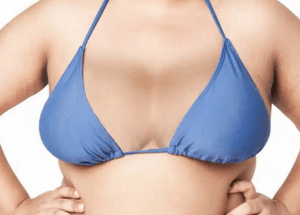
Treating Symmastia: Advanced Revision Techniques
Once symmastia develops, it cannot resolve on its own, and surgical repair is the only permanent solution. While compression garments may be attempted for very mild, early cases, surgery is required for definitive correction.
Surgical Correction Strategies
Banobagi specialists customize the revision strategy based on the patient’s unique anatomical needs and the original cause of the uniboob look.
- Capsulorrhaphy (Internal Suture Repair): The most common approach involves using permanent internal sutures to tighten the implant capsule and reattach it to the sternum, recreating a stable boundary between the breasts.
- Neosubpectoral Pocket Technique: For complex cases, surgeons may create an entirely new pocket between the pectoralis major muscle and the old capsule, then close off the old space to prevent the implants from returning to the midline.
- ADM or Mesh Reinforcement: Acellular Dermal Matrix (ADM) or biologic mesh can be used to reinforce the repair, strengthen the pocket boundaries, and provide long-term stability where tissue quality is poor.
- Implant Exchange: If oversized implants contributed to the issue, replacing them with smaller or narrower-profile implants is often necessary to reduce pressure on the repair and ensure it heals properly.
- Plane Conversion: If implants were subglandular, moving them to a submuscular (subpectoral) position provides added protection and support to keep them separated.
The Banobagi Standard: Safety and Expertise
Revision surgery for symmastia is highly challenging and requires meticulous reconstruction of the chest wall plane.
Why Choose Banobagi for Revision?
- Board-Certified Specialists: Our surgeons have extensive clinical experience and know-how in managing complex reoperation cases.
- Precision Technology: We utilize specialized surgical methods to minimize tissue damage and perform faster, more precise procedures.
- In-Depth Diagnosis: We conduct extensive pre-surgery examinations to understand the root cause of the complication and design a tailored solution for each patient.
- Safety Infrastructure: Banobagi features a team of full-time anesthesiologists and follows a surgeon real-name system for complete transparency.
Recovery and Long-Term Success
Recovery from symmastia repair requires strict adherence to post-operative care to prevent recurrence.
- Specialized Garments: Patients must wear a specialized compression garment, sometimes called a “thong bra” or a surgical bra with a central bolster, for 2 to 3 months to maintain pressure on the sternum and keep the breasts separated.
- Initial Healing: Most patients can resume daily activities within 3 to 5 days, but soreness and swelling may last several weeks.
- Stitch Removal: Sutures are typically removed about 7 days after surgery.
- Exercise Restrictions: Chest exercises and heavy lifting must be avoided for at least 3 months to ensure the internal stitches and tissue repairs are strong enough to support the implants.
Conclusion
Symmastia is a treatable complication that requires specialized surgical skill to restore a natural, defined cleavage. By choosing an experienced surgeon and following meticulous post-operative care, patients can eliminate the appearance of the “uniboob” and regain their quality of life.
Begin Your Journey
Connect with our expert surgeons to discuss your goals and discover the ideal approach tailored to you.
Why Choose Banobagi?
Two decades. Thousands of procedures. One standard: if it looks done, it's not done well enough. Every Banobagi surgeon operates within a tight specialisation. Fewer procedure types, more mastery. That's the model, and it works.
We're not the only clinic in Korea. We're the one other clinics measure themselves against.


 E-MAIL
